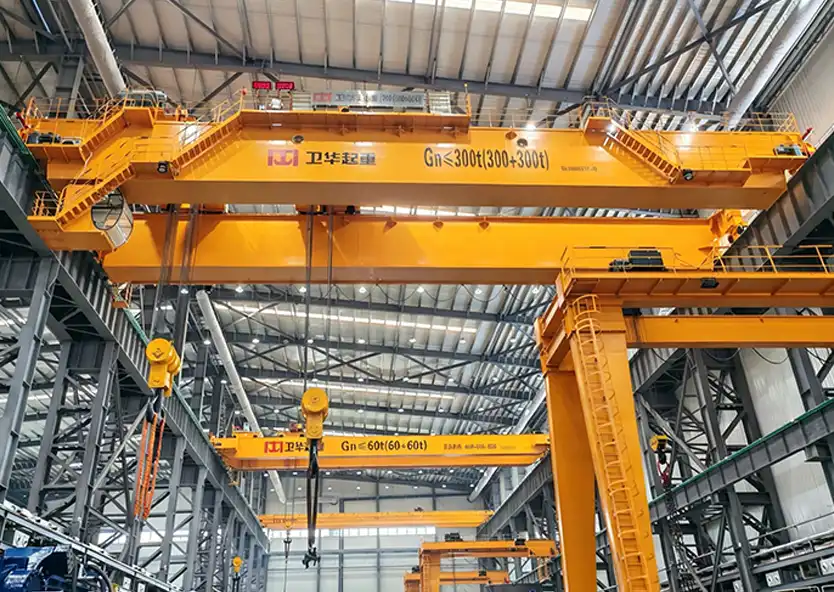
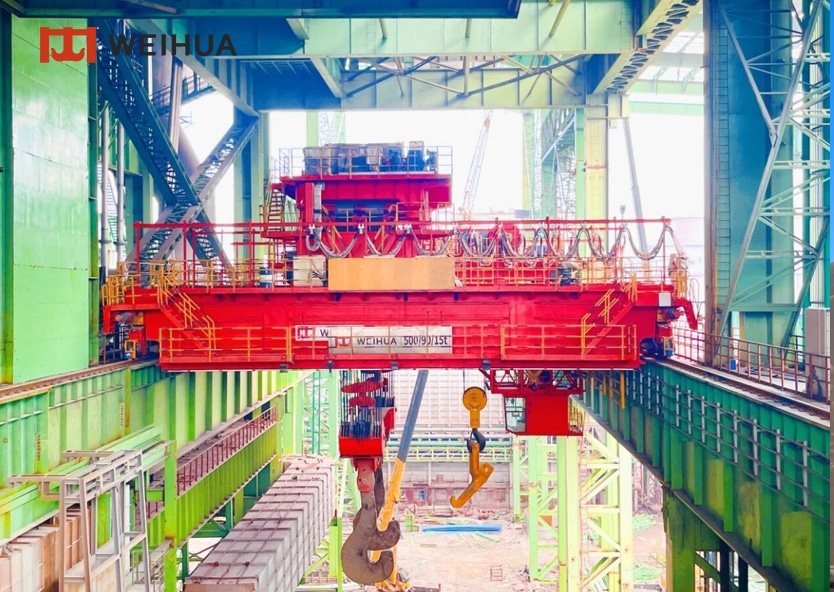
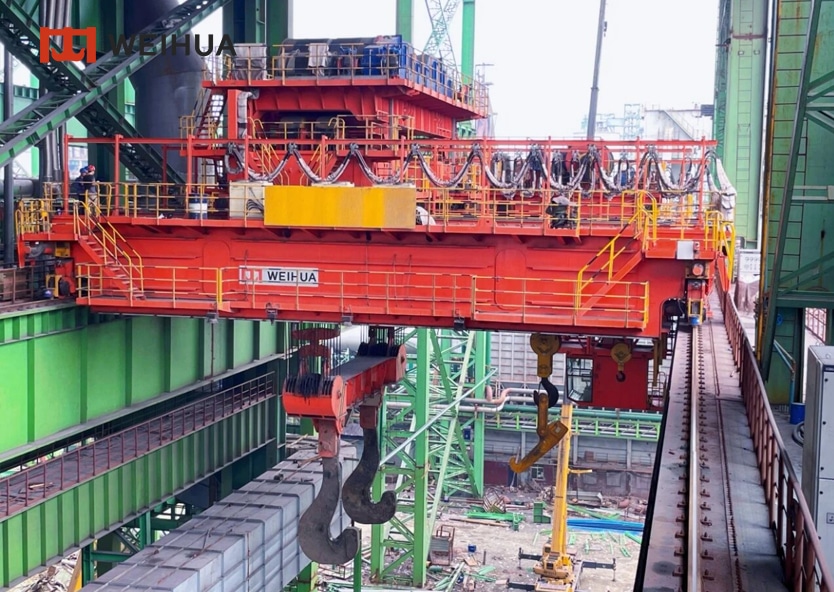
A 500-tonne double girder overhead crane spends most of its life doing something dull and essential: holding a ladle steady while steel is poured, or lifting a turbine casing off a shipyard floor. But when it arrives on site, it usually arrives as a convoy of sections thirty metres long, and it gets assembled in about a week. Everything between the customer’s first email and that week is what this article is about.
The honest version of how long that takes is somewhere between six months and a year, and the range is not really about how anyone builds. It’s about how long the design takes to be approved, how long steel takes to arrive, and how many times the drawing gets revised before anyone signs it.
The job starts on paper
Before a single plate is ordered, the engineers work from a requirements list the customer supplies: what’s being lifted, how heavy it actually gets, how often, the span between runway rails, the building’s clear height, the power supply, and what the environment does to steel — dust, heat, salt spray, acid fumes, an outdoor berth with the wind coming off the water.
For a crane this size, those answers determine nearly everything downstream. The team works out load distribution and dynamic factors, fatigue life under millions of cycles, deflections that a structure has to tolerate, and safety factors. Then the choices stack up: steel grades, the number of hoists, whether to use twin ropes or a single rope with a four-part reeving, gearbox ratios, brake holding capacity, the control architecture, whether the runway beams will support the whole thing or need reinforcing.
Every plate, bolt, weld, and motor gets specified. This phase is where mistakes are cheapest to fix, and manufacturers will tell you honestly that it’s the phase that saves them money — a revision on paper costs a drawing, while the same revision after the plate is cut costs the plate.
Cutting the plate
Fabricators start with heavy steel plate, usually 30 mm to 80 mm thick for this class of girder. Connection pads sometimes use even thicker stock. CNC profiling machines read programs pulled directly from the 3D model. They cut webs, flanges, stiffeners, gussets, and connection plates. The same run often drills bolt holes and machines weld bevels in one continuous operation.
Next, workers send these parts to grinding stations. They smooth every edge and apply special prep on all weld joints. Joint cleanliness and precise edge preparation almost fully determine final weld quality. Trapped slag or poor weld toes can spawn fatigue cracks years down the line, and these cracks give no early warning.
Teams run inspections at every stage. They verify plate thickness, cross-check dimensions, and match each piece against the cut list before moving components into fit-up.
Welding, which is where it becomes a crane
Fabricators build the girders as welded box structures: long hollow beams using top and bottom flange plates, paired with a vertical web and internal stiffeners. Workers do not hand-weld straight seams on plate of this thickness. Submerged arc welding handles those lengthy joints, while gas metal arc welding completes shorter segments and attachment welds. Larger workshops now automate these long seams more often. Automated equipment delivers consistent weld quality instead of relying on a single welder’s daily technique.
Once welding finishes, inspectors check every critical seam with non-destructive testing. They use ultrasonic testing on long butt welds and radiographic testing whenever specifications require it. When a seam shows a defect, crews gouge out the flawed material, re-weld the section, and run testing once more. This is standard procedure, not a defect manufacturers try to conceal.
Machining and fitting
While crews straighten cooling girders, other teams fabricate mechanical components. The trolley frame, hoist drums, gearboxes, wheels and brake assemblies all require machining to tight tolerances that surprise many buyers. A 500-tonne crane often uses twin hoists instead of one, so the two trolleys must share loads evenly. Misalignment makes the crane tilt while lifting and puts heavy strain on every wheel and bearing in the whole system.
End trucks — the assemblies that carry the full bridge along the runway — receive machining to match the exact rail profile buyers install on site. Technicians set wheels to fit the runway’s required gauge. Misalignment here creates uneven rail wear and early wheel failure, and fixing this fault costs a great deal once installed.
Once teams sign off on drawings, all parts move into a dedicated assembly bay. Fitters bolt, pin, and join components following drawing sequences, then recheck all dimensions. Workers disassemble the crane afterwards for shipping, but full assembly must happen first. Teams cannot fit parts they have not built yet.
Testing
Responsible manufacturers run full factory testing on cranes of this scale; they do not skip this sequence.
The first stage is no-load cycling: bridge travel, trolley movement and hoist lifting/lowering. Operators cycle all mechanisms to confirm no binding, rattling or unexpected control behaviour. Next comes load testing with calibrated test weights, not the buyer’s actual production cargo. The standard test load hits 125% of rated capacity, a load higher than normal working conditions. This test lets engineers track how every component behaves under stress.
Sensors record main girder deflection, brake performance, stopping distance, load creep, motor current, plus readings from overload protection and emergency stop systems. Some buyers request third-party inspection or additional unloading tests. Teams only release the crane for delivery once all checks pass.
Paint, packing, and the road
Raw steel arrives plain and leaves the factory with a finished coating. Crews shot-blast surfaces to near-white Sa 2.5 standard, then apply coatings. Most systems use epoxy primer topped with polyurethane or similar topcoats. Teams apply thicker layers on areas exposed to weather or chemical exposure. Colour usually follows the buyer’s plant specification; mismatched crane paint stands out permanently on site.
Shipping itself counts as a major project. Some girder segments stretch longer than 30 metres, so crews break them into sections and ship via heavy-haul trailers. They sequence these pieces to match site erection order, not just shipping convenience. Workers label every component, and site assembly crews rely entirely on these tags. One missing or mis-marked part can delay on-site assembly by multiple days.
What makes it work
Many people describe this work as craftsmanship, and that description holds some truth. But the core principle is less glamorous: every team follows documented steps, not informal oversight. Staff sign their names to each sign-off checkpoint and take accountability for their work.
Every production stage depends on prior work. A girder design revision in week six changes the cut list, shifts steel plate orders, pushes back welding timelines and delays factory testing dates. Manufacturers that thrive in this industry share schedule updates openly with clients early on. They flag upcoming risks while teams still have time to adjust plans.
The crane ships as a collection of massive steel segments, and every single piece must meet specifications. Once crews erect and load it on site, the machine can operate reliably for decades. Most operators will never stop to think about the welds holding it all together. That is the target every factory worker keeps in mind.
Frequently Asked Questions
How long does it take to build a 500-tonne double girder overhead crane?
Six to twelve months from design approval through delivery is typical. Custom features, steel availability, test requirements and the buyer’s drawing review speed all shift this timeline.
What steel grades are used for a crane this size?
Fabricators commonly use Q345B and Q370qE or equivalent high-strength structural steel. Material selection balances strength, weldability and impact toughness. Engineers pick the exact grade based on load cycles and operating environment.
Can a 500-tonne crane be used outdoors?
Yes, with targeted modifications. Projects require wind protection, upgraded anti-corrosion coatings, sealed electrical cabinets and sometimes heated or damped control hardware. Site conditions must drive design choices, not standard catalogue specs.
How is the crane tested before shipment?
Teams complete no-load and load tests using calibrated weights. They measure all movement functions, brakes, overload protection and structural deflection. Some buyers arrange third-party inspectors to witness testing.
Which safety standards apply?
GB/T 3811, ISO 4301 and FEM 1.001 are common selections, based on destination country and industry sector. Requirements vary widely between these standards, so parties lock in the applicable standard at contract negotiation, not near shipment.
How does something this size reach the site?
Workers ship girders and other large components in sections on flatbed trailers or specialised heavy transport. Crews assemble everything on site, normally with mobile crane support. Full bridge erection usually wraps up within one or two work shifts.
请再减少一些被动语态。
如何进一步优化这段文本的被动语态减少效果?
有没有其他方法可以减少文本中的被动语态?