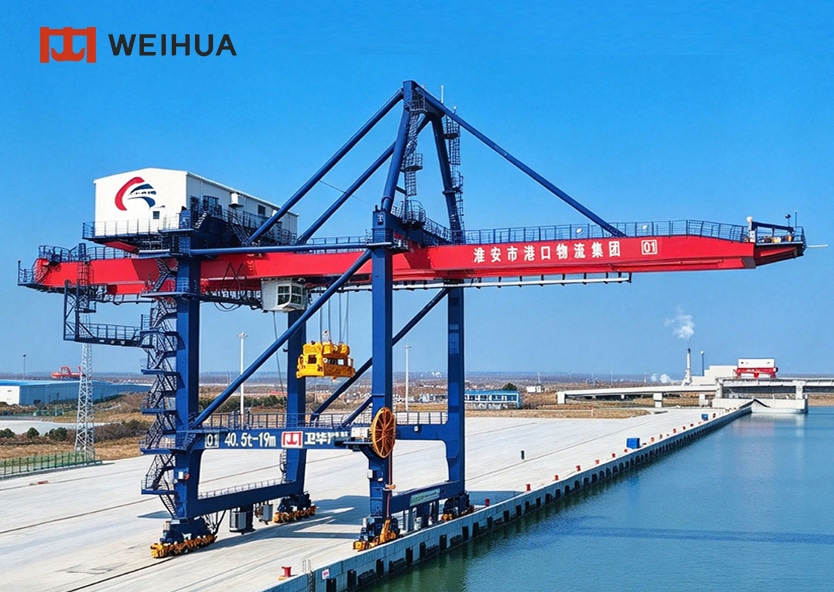
When a terminal plans container handling, the RTG vs. RMG cranes decision is one practical choice that shapes your daily handling capacity.
Two handling systems dominate container terminal work. You can use both types in one terminal, yet their working logic is not the same. We list their basic features, typical working scenarios, and practical pros and cons here. You are able to pick the right handling system and avoid rebuilding the yard later.
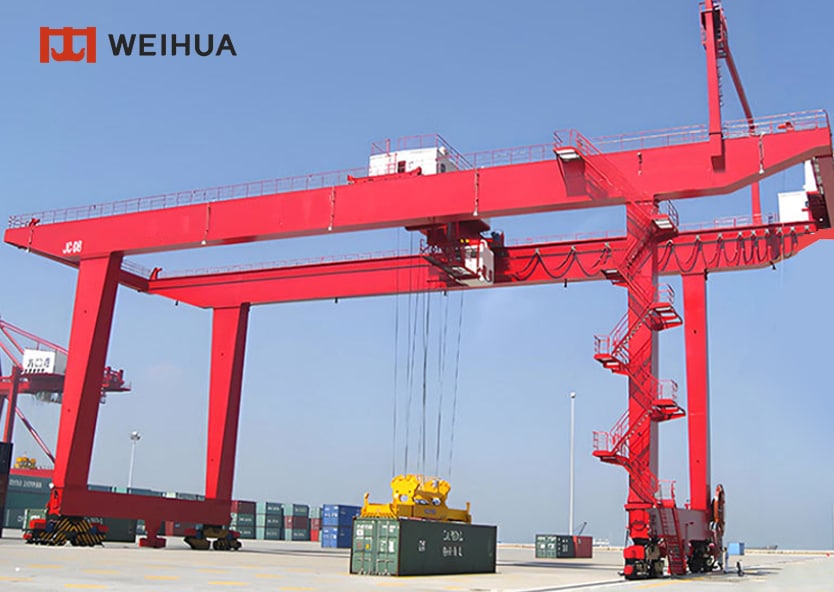
What Is an RMG Crane
The RMG crane is a rail-mounted gantry crane. It stands on steel rails, and the rails sit on a concrete foundation. The whole machine travels in one straight line, and the trolley moves on the gantry top. Weihua port RMG covers 35 t to 60 t, span 10.5 m to 50 m, working class A6 to A8.
This crane fits the terminal with a fixed and high-density layout. Hoisting speed is about 25 m/min to 50 m/min under full load, and gantry travel speed is about 100 m/min to 150 m/min. Because the running path never changes, it works the same block with high positioning accuracy, and this is the type that automated yards normally use.
It also carries clear limits. RMG cannot leave the rail, so any change of yard layout means new rail and new foundation. You cannot get flexible movement across the yard without rebuilding the track.
What Is an RTG Crane
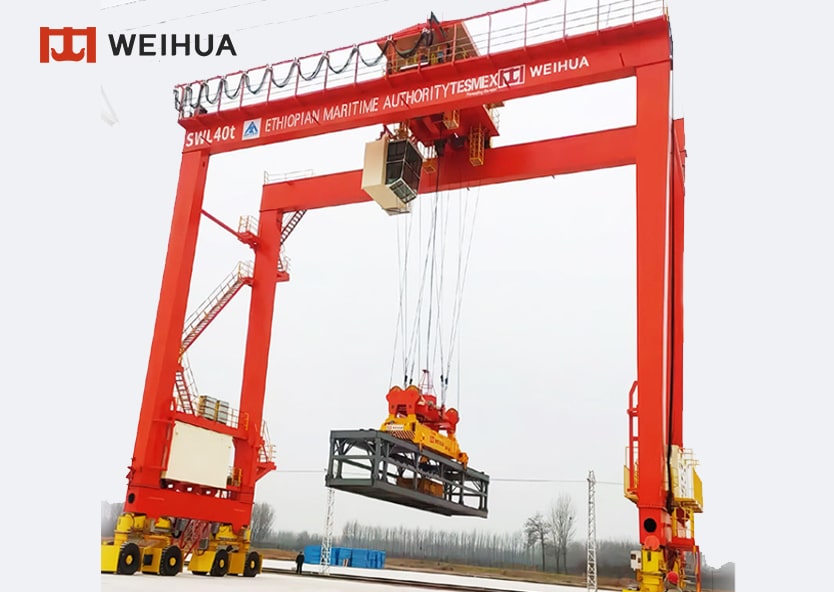
The RTG crane is a rubber-tyred gantry crane. It runs on wheels with rubber tyres instead of rail. The wheels drive the machine, and it can turn 90 degrees, change lanes, and travel to another block. No rail bed is needed, only flat and hardened ground.
This crane fits the terminal, which still changes. Weihua RTG covers 35 t to 50 t, working class from A6 to A7. Most of the machine type use 8 wheel or 16 wheel, and the drive type can be diesel electric, diesel hydraulic or full electric. The spreader is as important as the crane, because a telescopic spreader handles 20 ft, 40 ft, and 45 ft boxes on one machine.
On the downside, the RTG travel speed is much lower. Gantry travel speed is about 25 m/min to 30 m/min, compared with 100 m/min to 150 m/min for a rail machine, and stacking height normally reaches one container lower. You also need to check tyre and steering condition more often, and the open yard still needs wind monitoring.
Key Points to Compare Them Side by Side
Start with your yard layout. If the block position stays fixed for many years and you need high-density stacking beside the rail siding, RMG suits the job. If the yard still reorganises as volume grows, or one crane must serve several blocks, RTG gives you the movement. Many terminals with rail siding at one end finally run both types.
Next, check positioning accuracy and automation. The rail machine keeps tighter tolerances on where the spreader lands, and it is easier to combine with an automatic guide system, remote control, and yard management software. The rubber-tyred machine spreads the container more loosely, so the operator must watch the stacking pattern.
You also need to compare handling rates. RMG trolley speed is about 60 m/min to 120 m/min, and RTG trolley speed is about 60 m/min to 70 m/min. For a crane that repeats the same cycle on one line, the difference is small. For a crane that crosses the yard on every move, it adds up fast.
Budget is another factor. The RMG needs rail foundation, sleepers, and an installation team, so the civil cost grows and the schedule gets longer. RTG avoids this work and asks for hardened ground instead. Actual cost depends on ground condition and local labour rate. In the running years, RTG spends money on tyre and steering parts, RMG on rail and wheel inspection.
Quick Selection Checklist for RTG vs RMG Cranes
Ask yourself these simple questions before you decide. Does your yard layout stay fixed for ten years? Do you need one crane to serve several blocks? Do you run automatic or remote operation? Can your ground carry the machine?
If three or more answers point to a fixed layout and high-density stacking, then go for RMG. If most answers relate to changing yard and flexible movement, choose RTG. When you handle a mixed situation, talk to your crane supplier. They can suggest a mixed fleet, shared control system, and spreader plan.
Frequently Asked Questions
1. Which crane moves containers faster?
It depends on the travel distance of each cycle. The RMG covers its rail at about 100 m/min to 150 m/min and stays in the same block, so it wins on long and repeated moves. RTG crosses the yard more slowly, but it saves the waiting time of a fixed crane.
2. Do I need rail foundation for an RMG?
Yes. The RMG runs on fixed rail, so you must build the track, the sleeper, and the foundation before the crane arrives. This civil work is usually the highest hidden cost of an RMG project.
3. Can an RTG work without a rail bed?
Yes. It runs on rubber tyres over the flat, hardened ground and needs no rail at all. This is the main reason why terminals choose RTG for a yard that is still changing.
4. Can one terminal use both RMG and RTG?
Yes, and many do, because RMG and RTG solve different problems in the yard. The common arrangement puts RMG along the rail siding for transfer work, and RTG in the stacking block where the crane must move between row and column. Modjo Dry Port in Ethiopia runs two RMG and three RTG this way.
5. Which crane stacks containers higher?
Usually the RMG. It commonly stacks five or six containers high and passes over one layer, while RTG normally reaches four or five high. Actual available height depends on the spreader.
6. Which crane suits automatic terminal operation?
The RMG, in most cases, because its fixed path removes most of the positioning guesswork and makes it easier to combine with an automatic guide system, remote control, and yard management software. RTG can also be automatic, but the yard layout must be planned around the steering space.